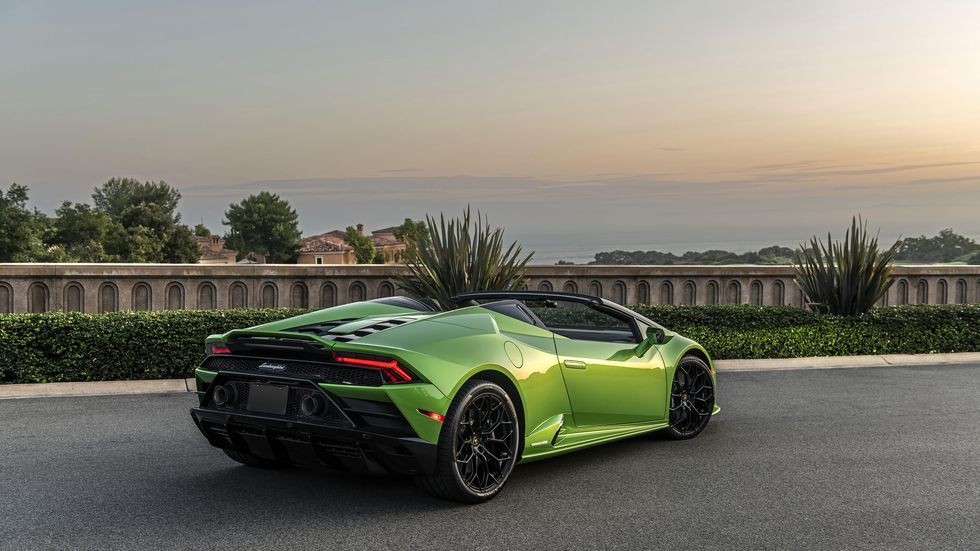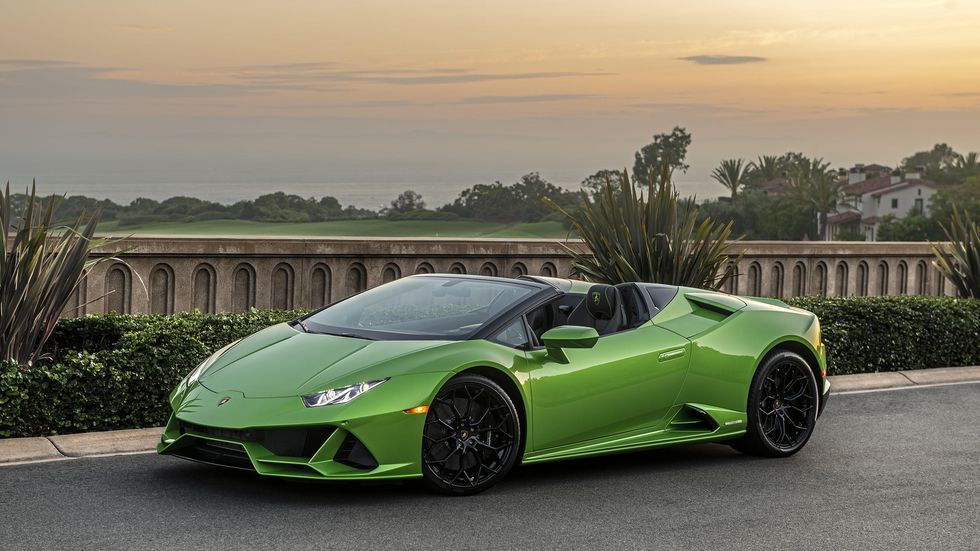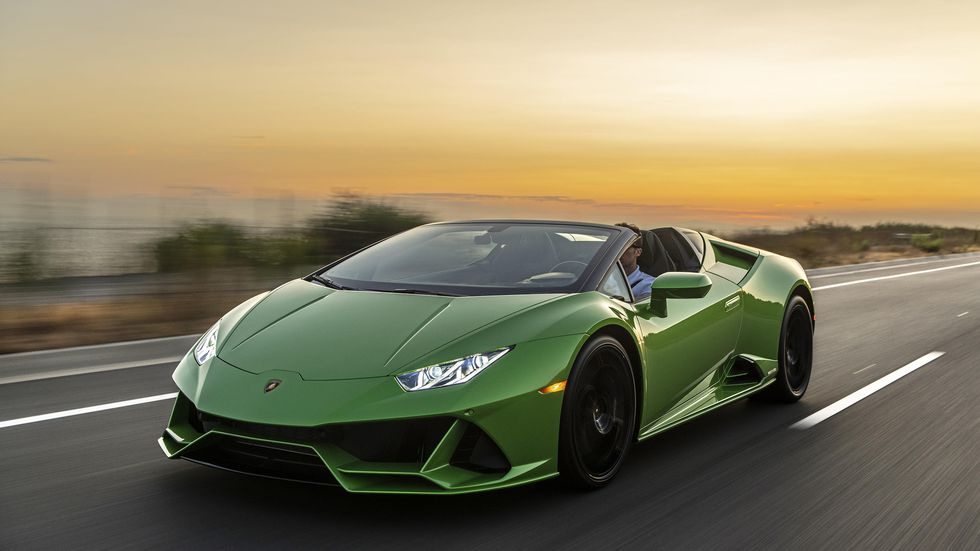
We are too often wrapped in the information. Lamborghinis discussions are often spotted with information on acceleration, lap times, and hyperbolic top speeds. At the end of the day, however impressive they may be, these performance metrics are not what sells a new Huracán Evo Spyder.
Rather, it’s the capacity of the car to make you look and feel like a million dollars, even if you’re just getting into traffic.
After all, you don’t even need to mention its significant authority; at a standstill, the Huracán Evo Spyder 2020 creates a stir.
All done with angles and points and aggression, the Huracán is a textbook definition of what a supercar is supposed to be: it’s overworked borderline, yet at the same moment beautifully cohesive.
I can’t say that I prefer the fresh look of the Evo to that of its predecessor— I understand the mildly updated bodywork enhances aerodynamic flow, but it almost feels like styling for the sake of fun. Nevertheless, please Lamborghini to keep the design of the Evo so close to that of its progenitor. Five years on, the shape of the Huracán is as amazing now as ever.
Of course, with its top-down, the Spyder is best regarded, the electronically folding roof completing its disappearing act in a scant 17 seconds. The angle of the windscreen of the Huracán and the arc of its back buttresses take your eyes from one to the other, so even with the gap between its pillars, the profile of the Spyder cuts off a completely seamless shape.
If there is a downside to the design of the droptop, the storage compartment of the roof implies that there is no large glass panel through which the 5.2-liter V10 engine can be viewed. Instead, the boot of the Spyder lifts up to show an unflattering glimpse of the butt of the engine, although I enjoy the Evo incorporating the higher-mounted exhaust outlets first seen on the Huracán Performante.
The engine, however, is an utter sweetheart, reviving with naturally aspired ferocity to high heaven. Strada, Sport and Corsa drive modes all have different volumes and pitches to sing, and the latter one of those three devilishly delightful sounds, whether you floor it past 5,000 rpm or just throw a few playful blips as demanded by wide-eyed children at busy junctions.
All Evos use the outgoing Huracán Performante V10 tune, meaning 631 horsepower and 442 pound-feet of torque are available. Even with its 256-pound penalty over the Evo Coupe, the Huracán Spyder rockets with immediacy away from the stoplights— an implacable linear power delivery crescendo.
Digging into the figures for a moment, Lamborghini claims the Evo Spyder will accelerate in 3.1 seconds to 60 miles per hour, two-tenths of a second faster than the Coupe. But unless you drag another Huracán owner to race, this short delay in time will not really create a difference.
The Huracán Evo Spyder is just as exciting to launch as its fixed-roof counterpart, the seven-speed, dual-clutch gearbox upshifting with a timely urgency, regardless of whether I leave the transmission to its own devices or use the large metal paddle shifters of the Spyder.
Besides, for the warm breeze against my skin, I will gladly trade two pointless tenths of a second and that symphonic V10 switched up to complete volume.
In a Huracán Evo Spyder, the hardest part of commuting is finding the restraint not to bury the throttle at every traffic gap.
The Huracán has some additional performance tricks up its sleeve for its Evo incarnation.
The redesigned traction control and rear-axle steering systems are borrowed from the bigger Aventador S, while the fresh torque-vectoring technology shuffles better energy between all four wheels. The updated aerodynamics of the vehicle is said to generate five times the outgoing Huracán Spyder’s downforce, and all of this works together to create a much sharper vehicle than before.
The Spyder transforms with such immediacy in that it honestly feels a little twitchy at first. However, the longer I drive the Evo, the more I adapt to its rapid lightning reflexes. This car is so precise in its conduct and ready to rotate while turning that it almost compensates for the steering feel that is resolutely numb.
What really seals the deal is the new Lamborghini Dinamica Veicolo Integrata (LDVI) tech from Evo, which uses data from a whole bunch of sensors to predict how much electronic driving intervention is needed before it even becomes necessary.
Instead of reacting to understeer or oversteer moments, LVDI factors in the speed of the car, driver inputs and the amount of grip available to mitigate sloppiness ahead of time.
You can’t really feel anything from behind the wheel, and that’s a nice thing. The LVDI scheme feels like a natural aspect of the on-road manners of the Evo and enables me to push harder and harder with each fresh corner with greater confidence.
That said, perhaps more important to the Spyder’s mission statement is how friendly the Huracán Evo is to drive around town at legal speeds— say, on a sunny July morning along the Pacific Coast Highway in California.
The magnetorheological dampers even in its most balls-out setting smooth out pavement imperfections for a graceful and, I dare say, supple ride quality. Honestly, in a Huracán Evo Spyder, the hardest part of commuting finds the restraint not to bury the throttle at every traffic gap.
Well, it doesn’t get a sunburn (ask me how I understand it).
Headroom is hardly an issue beyond the splendid V10’s amplification without a roof above you. That’s a good thing because seeing from the Huracán Spyder is hard for even bigger drivers like me.
The top of the windscreen goes directly through my sightline when I attempt to see if the stoplight has changed from red to green. Removing the roof also improves visibility on the side and back, even though both are pitiful. Thank you for the backup camera mandated by the federal government.
A fresh 8.4-inch touchscreen takes up room on the center console when it comes to onboard technology, housing the recent infotainment software from Lamborghini.
No longer a bastardized version of Audi’s old MMI tech, setting up the Huracán isn’t the simplest or cleanest to do. At least it involves some really helpful controls of the gesture, such as the capacity to swipe up or down the screen at any moment to boost or decrease the quantity of audio.
Apple CarPlay is included, but there is nowhere to find Android Auto. And while I’m sure Android users will get used to taking on infotainment by Lamborghini slowly but surely, if you’re an iPhone man or gal, CarPlay is definitely the way to go.
Are there any other issues? I guess. I guess. Talking to passengers in the Spyder isn’t as simple as that, what with all that added wind noise. And I don’t think the Huracán is precisely practical, its frunk can only hold a few backpacks.
The Spyder costs approximately $26,000 more than the Huracán Evo Coupe at $287,400, although if you spend more than $250,000 on what is essentially a lifestyle accessory, you can almost certainly spare the extra coin.
The bottom line is that the Evo is the Lamborghini Huracán’s finest version, and the Spyder only increases the experience.
It’s as visually gripping and amazing to ride as its counterpart to the Coupe, and with the top folded back on a lovely summer day, you’re not even worried that it’s ever so slow.